Furnace repair answering service and virtual receptionist
A furnace repair answering service has two jobs: answer the no-heat calls that pile up the morning after the first cold snap, and handle every gas smell and carbon monoxide alarm with the right words. Sonic Receptionist, our virtual receptionist for heating companies, does both. It gives fixed safety instructions first, turns no-heat calls into urgent messages or booked repairs, and fills your calendar with fall furnace tune-ups before the freeze.
Book a demoSee pricing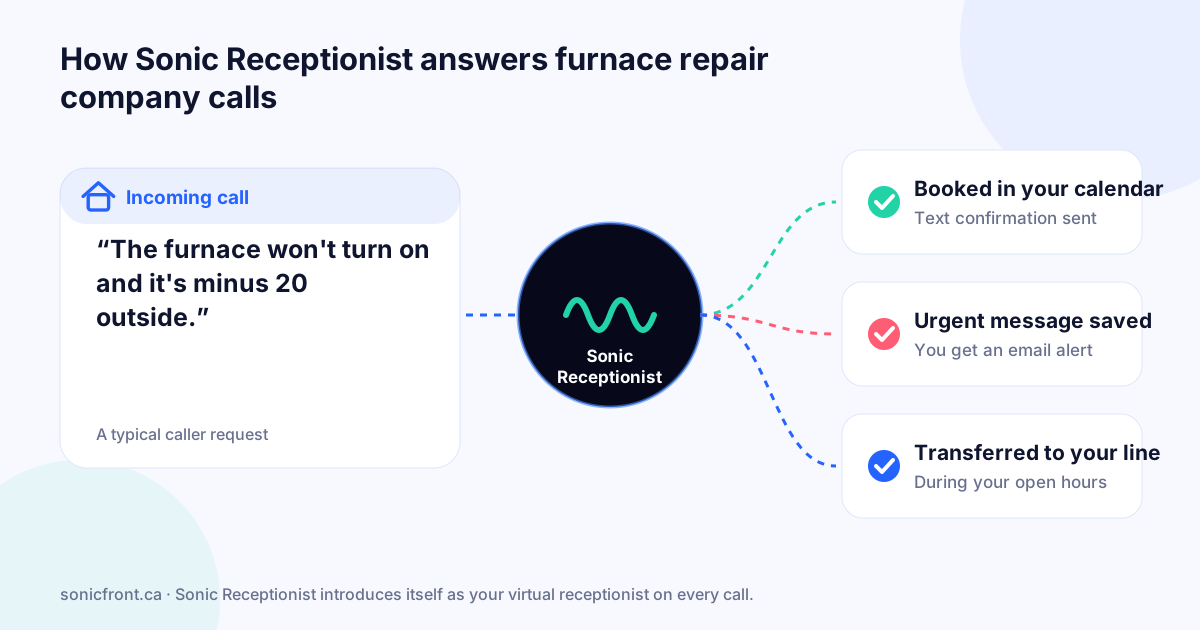
Missed calls in furnace repair start at 6 am
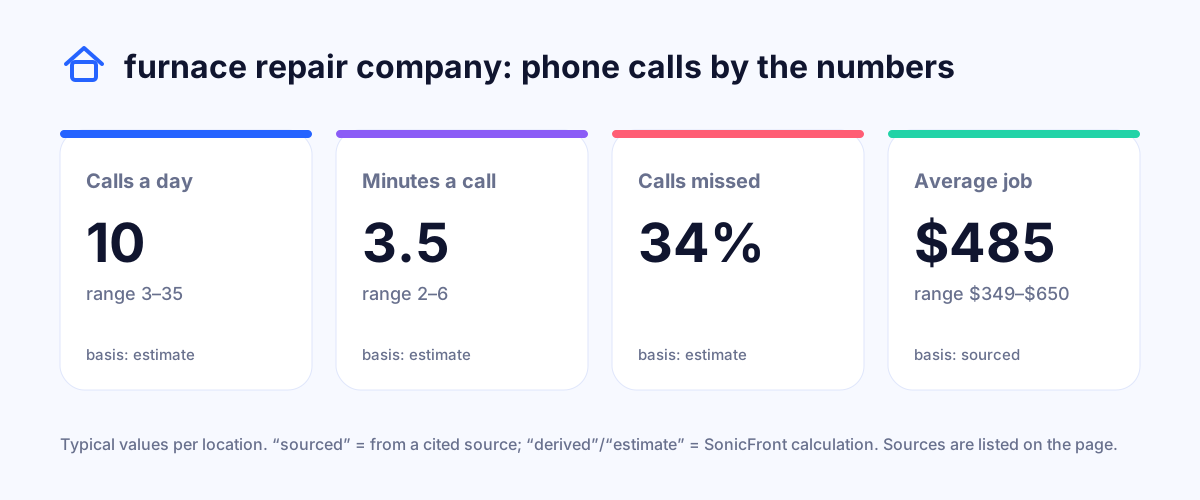
Heating calls don't wait for office hours. ServiceTitan's call data shows about 1 in 8 trade calls arrives outside business hours [1], and for heating the worst hours are early: the house is cold when the family wakes up. Meanwhile a person answers only 34% of HVAC calls in Invoca's per-trade data [2].
- The first cold snap. Furnaces sit idle all summer. The first freezing night, ignitors and pilots that worked in April don't light, and the calls arrive together at 6-9 am, before your office opens.
- Deep-freeze weeks. In December to February a no-heat call can mean frozen pipes by nightfall. The caller who reaches voicemail calls the next company, and that company gets the repair and probably the replacement.
- Safety calls mixed in. About 1 call in 20 in heating season is a gas smell or CO alarm by our estimate. Those need the same calm, correct script every time, whoever picks up.
What Sonic Receptionist does on heating calls
| Caller says | Sonic Receptionist |
|---|---|
| “I smell gas near the furnace.” | Fixed script, every time: leave the house now, don't touch light switches or phones inside, and call the gas utility or 911 from outside. Then it takes a message. Never troubleshooting. |
| “My carbon monoxide detector is beeping.” | Tells everyone to get outside and call 911. Fixed wording, no questions about the furnace first. |
| “The furnace won't turn on and it's minus 20 outside.” | Asks who is at home and whether pipes may freeze. Seniors, infants or freezing risk make it urgent: transfer in open hours, an emailed urgent message marked NO HEAT after hours. Otherwise it books the first repair slot. |
| “It's blowing cold air.” | Books a no-heat service call in your Google Calendar and notes the symptom for your tech. No guessing at the cause. |
| “The furnace keeps turning on and off.” | Books a repair visit and texts a confirmation. |
| “Can you do a fall furnace cleaning?” | Books the tune-up from your calendar and explains your maintenance plan in your approved words. |
| “How much is an emergency call on a Sunday?” | Quotes your approved after-hours or weekend fee, or takes a message if you haven't set one. |
| “Do you replace furnaces? What would it cost?” | Books an in-home estimate. It never quotes a system price you haven't approved. |
| “Is the technician still coming this morning?” | Takes a message so dispatch can confirm. It never makes up an arrival time. |
After-hours answering for furnace repair, from midnight to 6 am
- Open hours: when the morning rush hits, overflow calls are answered instead of ringing out, and urgent no-heat callers are transferred to your office line.
- After hours: every no-heat call is written up with the address, who is at home, freezing risk and a callback number. Urgent ones are emailed to you right away so your on-call tech can decide.
- Every day: fall tune-ups, repair bookings, reschedules and cancellations go into your calendar with a text confirmation, and every call is logged in your dashboard.
Works with how heating companies schedule
Today Sonic Receptionist books into Google Calendar, texts confirmations, emails urgent messages and logs every call. Booking straight into ServiceTitan, Housecall Pro, Jobber, FieldEdge or Service Fusion is on our roadmap; ask us about the one you use.
Google Calendar (today)ServiceTitan (roadmap)Housecall Pro (roadmap)Jobber (roadmap)FieldEdge (roadmap)Service Fusion (roadmap)
The first-cold-snap surge: what one week of missed calls costs
Fixr puts the average furnace repair at $485, in a range of $349-$650, with heat exchanger jobs running much higher [3]. About 38% of home-service calls are real sales leads [5], and ServiceTitan's typical HVAC booking rate is 38% [4]. From those numbers we estimate a missed heating call is worth about $70 before any replacement or maintenance plan.
At about 10 calls a day and a third of them missed, that's about $5,200 a month by our estimate. But the first cold snap doesn't spread itself over a month. If half a month's no-heat calls arrive in one week, most of that loss happens in those five days, and the customers you lose then are the ones who'll need a new furnace in a few years.
The safety script every heating call needs
Whoever answers your phone, the safety wording should be written down and never improvised. Here's what we use, and what you approve before go-live:
- Gas smell: leave the building, don't touch switches, call the gas utility or 911 from outside.
- CO alarm: everyone outside, call 911. No questions about the furnace until the caller is safe.
- No heat, freezing risk: urgent. Who's at home, how cold is it inside, are any pipes on outside walls?
- Never: relight the pilot, reset the gas valve, take the panel off, or heat the home with an oven or barbecue.
Fill the calendar with fall tune-ups before the freeze
Every furnace you tune in September is one less 6 am no-heat call in January. Fall is when homeowners call about cleanings, and it's also when your office is quietest. A virtual receptionist that books tune-ups any hour, including evenings when people actually think about it, keeps your techs busy in the shoulder season.
Ask it to mention your maintenance plan on every tune-up call, in the words you approve, and to offer the next open slot rather than leaving it to a callback.
What to ask anyone who answers your heating calls
Live answering services such as Ruby start around $720 a month for 200 minutes [6], and an in-house CSR costs about $3,700 a month by our estimate. Before signing with anyone, ask them to read you their gas-smell script. Ask whether they book tune-ups into your calendar or only take messages, how they handle ten calls at 7 am, and whether they ever quote prices or arrival times.
Sonic Receptionist answers every line at once, uses your approved safety script on every gas and CO call, and books straight into your calendar.
How setup works
- Answer the heating owner questionnaire: furnace, boiler and heat pump services, brands, service area, fees callers may hear, your maintenance plan and your no-heat urgency rules.
- We connect your phone number and Google Calendar, set repair and tune-up booking windows, and choose when calls transfer to you.
- You review every answer and the safety scripts before a caller hears them, and update them any time from your dashboard.
- Go live before the first cold snap, usually within a couple of days, for after hours, overflow or every call.
Pricing
| Plan | Price | Includes |
|---|---|---|
| Essentials | $249 / month | 150 connected voice minutes, 1 number, 1 location, knowledge and message taking, calendar booking, basic analytics, 500 SMS segments |
| Growth | $599 / month | 450 connected voice minutes, 2 numbers, 2 locations, everything in Essentials, unified inbox and automations, advanced routing, 1,500 SMS segments |
| Scale | $1,299 / month | 1,000 connected voice minutes, 5 numbers, 5 locations, everything in Growth, API and webhooks, advanced analytics, priority support |
| Enterprise | $2,999+ / month | 2,300+ connected voice minutes, custom integrations, SLA and dedicated onboarding, multi-location governance |
Launch pricing in USD. Annual billing saves 10%. One-time onboarding and usage overage apply. Taxes and exceptional carrier charges are shown separately. Compare all plans.
Answering every call at a typical furnace repair location in heating season is about 770 minutes a month by our estimate (about 10 calls a day at 3-4 minutes each), which fits Scale. Covering only nights, weekends and the morning overflow is roughly 35-50% of that and fits Growth.
Questions from furnace repair company owners
Will callers know it's automated?
Yes. Sonic Receptionist introduces itself as your company's virtual receptionist on every call, and if a caller asks whether they're talking to a person, it says plainly that it's an automated assistant. In open hours it can transfer the caller to your office; otherwise it takes a message for a callback. See our automated call disclosure.
How does an after-hours answering service handle a gas smell at night?
It gives the fixed safety instructions first: leave the house, don't touch switches, call the gas utility or 911 from outside. Then it takes a message for you. It never troubleshoots a gas call.
What happens to a no-heat call at 6 am before we open?
It asks who is at home and whether pipes may freeze, and takes the address and a callback number. Urgent calls are emailed to you right away; the rest are booked into your first open slot with a text confirmation.
Can it book fall furnace tune-ups?
Yes. It books, reschedules and cancels tune-ups in Google Calendar within your hours and can explain your maintenance plan in your approved words.
Will it tell a homeowner to relight the pilot?
No. It never gives pilot, gas valve or panel instructions, and never diagnoses the furnace.
Is this a heating contractor call answering service for the whole year?
You choose. Many companies use it for every call in heating season and for after hours only in the summer.
Be answering before the first freeze
Book a demo and hear Sonic Receptionist handle a gas-smell call and book a fall furnace tune-up.
Book a demoSee all industriesRelated industries: HVAC / heating & air conditioning
Sources
- ServiceTitan, Call Trends in the Trades (off-hours share), 2026. servicetitan.com
- Stealth Agents, Home services missed-call revenue statistics 2026 (citing Invoca per-trade answer rates). stealthagents.com
- Fixr, Cost to repair a furnace, 2025. fixr.com
- ServiceTitan, typical call booking rate for HVAC and other trades, 2022. servicetitan.com
- Invoca, Home Services Lead Conversion Benchmarks Report, 2026. invoca.com
- Ruby, receptionist plans and pricing, 2026. ruby.com
Numbers marked “about” or “we estimate” are SonicFront estimates from the sources above, per typical location. Your own numbers will differ; the dashboard shows your real call volume after go-live.